
Communicating Vessels
by Bernard Martoïa
A gurgle was comforting as it signaled that the central heating system of the building started up in the wee hours of the morning. However, the daydreamer was impervious to that noticeable improvement while keeping his forehead glued to an icy window panel.
Piece by piece, the jet-lagged traveler reconstructed his tumultuous journey the day before. It began with a three-hour drive to Nice Côte d’Azur Airport under torrential rain. A tense farewell from his father portended a hazardous take-off above the water’s surface, which had every appearance of an unmitigated disaster. On the second leg of his flight, a clumsy neighbor spilled red wine on a sweater with sentimental value. The intercontinental voyage ended with a dicey touchdown with crab technique in a strong crosswind at John F. Kennedy International Airport. A prolonged wait in getting through Immigration and Customs formalities finished him off.
Ultimately, the drained traveler arrived by bus in Manhattan, where a benevolent colleague put him in his apartment. The sojourner fell asleep, in a blip, on a convertible sofa in a small room that served as an office space.
The guest did not remember anything in between. Since his watch indicated 10:27 a.m. (Greenwich Time), he adjusted it to 4:27 a.m. (Eastern Time). Because the jet lag prevented him from falling back to sleep, he turned on the light of a vintage green shade desk lamp and resumed reading in German Der Verschollene (Amerika: or The Man who disappeared) by Franz Kafka.
Like in Cinderella’s fairy tale, the main character, Karl Rossman, did not return to his uncle Jacob’s home before the midnight deadline. The wealthy kinsman disinherited the nephew for that petty disobedience. After wandering in the countryside with two drifters who promised to find work but took advantage of him instead, the destitute returned to New York.
At the Hotel Occidental, a manageress of German extraction hired Karl as a lift boy. She claimed it would be the best way to climb the social ladder. Impressed by her pretense reflecting a general opinion that America was the land of opportunity, the gullible recruit did more than his share of the work while shining the elevator buttons ardently and assisting guests with trivial issues.
Two months later, the hardworking recruit faced a dilemma when Delamarche, an intoxicated drifter he had met before, disrupted the hotel’s lobby during the night shift. Karl was sacked for leaving the elevator unattended while lodging the raucous acquaintance in the lift boy’s sleeping quarters.
“The poor fellow makes plans that consistently fail to materialize. Will I fare better than him?” wondered the reader. Engrossed in Kafka’s realm, he kept devouring the book until he perceived the host moving around.
The two bachelors breakfasted with a pronounced French flavor, including grilled toast, bitter orange marmalade, butter, and strong black coffee. There was no talk save polite requests around the table. Their entities were reduced to protruding limbs spreading butter on toast and interacting with a monitor on a kitchen countertop.
An attractive red-haired anchorwoman spouted lame talking points, but the host listened as though they were the gospel truth. Adrien put a good face on that perennial intruder that destroyed a semblance of everyday life. He did not own a television because he considered it time-consuming, mainly commercial advertising that polluted an exciting film or a riveting documentary.
Still, he remembered when the Dallas series sold a reborn American ideal. The sudsy portrayal of wealth, sex, intrigue, and power struggles made people dream. Tanned thespians lived in a world other than the man of the street. He sighed when an enraptured viewer broached an episode. The consolation was that it would be a boring world if everybody agreed on everything.
A catchphrase illustrated insidious brainwashing. “You are what you watch!” Survey after survey showed that television affected the viewer’s cognitive ability.
Only the weather forecast mattered to the newcomer. Since Gotham was bracing for a cold snap, he worried that his crumpled attire was neither presentable nor warm enough. The Paris-based moving company assumed the container would arrive in New York harbor on time. With that knowledge, the gullible traveler crammed his essential clothing and toiletries into one hard-shell suitcase. On schedule, the container ship left Le Havre, France, but the moving company lost track of Adrien’s belonging when the boat docked in New York harbor ten days later.
Although the container did not vanish in the Bermuda Triangle, it was nowhere to be found. Unknown to the concerned party, her dossier was shunted in another mysterious triangle formed by the United States Customs Service, the New York Port Authority, and the State Department. Because none of the three administrations wanted to deal with the issue, they just kept passing the parcel. On the receiving hand was the secretary of the moving company. She was clueless about the client’s whereabouts.
After fruitless and embarrassing calls, Adrien gave up hope of retrieving his possessions. Curiously, the imbroglio lasted precisely forty days. With its biblical reference, the probational time frame tested the migrant’s endurance to bear doubt, anguish, frustration, and atonement. The impenetrable deadlock exasperated him so much that he wanted to chuck it all in and return to France.
Regardless of the kafkaesque parenthesis in the offing, there was no rush since the office was a few blocks away.
As soon as Adrien sallied out in the street, he raised his head toward the sky dimly lighted by a waxing gibbous moon. It was the indecisive and exquisite hour that said neither yes nor no. There was enough daylight to see at close range but not enough to get lost at some distance. The alien was bewitched by this august and caressing serenity. During that sublime moment, suffering gave up harassing the fresh-of-the-boat, who had been tossed in his doubts. Peace wrapped the careworn migrant in a cocoon, and any disquietude was put on the back burner.
Above a canopy of high-rise buildings, the newcomer distinguished vapor trails in a blue velvet sky. A mysterious throb filled the space from every direction. The outlander contemplated the metropolis as a delphic beehive whose level of intricacy was beyond his understanding. Although he could not absorb so much change in his mundane existence, the hustle and bustle of Gotham was invigorating.
After craning his neck to feast his eyes on skyscrapers—a potent symbol of Wall Street’s financial clout—the observer directed his gaze at an early bird wrapped in an eye-catching white hood coat. The creature cruised past him on a concrete sidewalk, as broad as any street in the Latin Quarter, frequented by students, budding artists, and writers in Paris.
The catchy sway of hips hinted that the walker either belonged to the fairer sex in the courteous address of the gallant Abbott in Ivanhoe by Walter Scott or to the second sex in remembrance of the flagship title of Simone de Beauvoir’s book.
Beauvoir’s essay did not refer to sexuality, but the female gender, which she considered a default choice in a patriarchal society. She believed that perceptions of gender were not biologically inherited but imposed by society. “We are not born women; we become women.” The slogan made her the standard-bearer of the second wave of feminism.
On a side note, Beauvoir wrote the book in the Café de Flore on Saint Germain boulevard. “Little was essential to have a single room, which lacked charm. I had Paris, its streets, squares, and cafés.” Her nomadism was dictated by financial strain. During the Phony War, the new owner of the Café de Flore installed a powerful coal stove that could heat the second floor, where few clients ventured before its installation. Beauvoir sat at one of the dozen tables on the second floor to write peacefully. The friendly landlord let her stay all day without consuming much. Writers and artists frequented cafés not to show off but to escape from their dank, unheated maid’s room in the attic.
The tempted onlooker did not ask himself the right question about the choice of words used for women at different periods in time. He forced the pace while relying upon his gut feeling. The speed increment was worth the effort. When the chaser caught up with the passerby, he discovered a sweet little face shrouded in a broad hood billowing in a cold breeze.
“God produces miracles as he sees fit. He has built this lovely creature, and providence has placed it on my path,” surmised the newcomer in one go. He was never short of asinine expectations when his brain was full of effervescence. In this context, an intriguing passage from Les Misérables by Victor Hugo came to his mind. “God had built this charming Cosette, and he had employed Jean Valjean. It had pleased him to choose this strange collaborator.” In his fanciful world of books, Adrien put himself in the shoes of an old convict to chaperone a sprightly damsel.
“She has a mole above the upper lip, which signifies social success,” deduced the onlooker hastily.
Nonetheless, the trailer did not go overboard in dealing with the colleen who bore more than a passing resemblance to Holly Golightly’s character. What interested him presently was an anecdotal item in the golden girl’s paraphernalia. She carried a styrofoam cup containing an odorous substance. Because the stranger had never seen someone so fully equipped to handle the rigors of winter, he came out of his shell by asking tactfully about the flavor.
The Fräulein stopped in the middle of his hot air. She took her time to inspect the interloper from head to foot, just in case a segment in his lineaments might be worth a serious look. After satisfying her unhealthy curiosity of scanning the stranger with predatory detachment and listening to his rigmarole with one ear, she answered with an incredible bass voice, “Excuse me, but I do not understand your question.”
The pushover was startled because he did not expect the willowy brunette to speak with such a deep timbre. He repeated it while accentuating each syllable and spreading his hands, palms upwards, to be understood. The issue’s core was that he was not overly much in the habit of giving his tiny grey cells a workout in the language of Shakespeare. More unsatisfactorily, he had raised his voice to be understood. A gentleman was to be measured in his speech in any circumstances.
The lass’s face registered incredulity when the interloper reeled off the entreaty with a theatrical gesture. She gawked at the alien with great perplexity. Her dilated blue eyes followed the pantomime while her mouth stood agape.
“Spare me the sweet talk,” was the initial thought brooding in her upper story when the stranger approached her. Since the meddler expressed himself with an unmistakable foreign accent, she registered the novelty in the babel.
“Oh, it is just coffee with hazelnut flavor,” she said flatly before adding, out of curiosity, “Are you from Germany?”
“No, I am a French citizen,” replied lamely the nosey parker. Deep within him, he was annoyed to be mistaken for a national across the Rhine.
The Doppelgänger of Holly Golightly did not lend an ear to his remark. She looked at her vintage gold plating wristwatch and whistled the end of the game by saying, “You will have to excuse my language here, but my train leaves the station at 7:28 a.m. on the dot!”
The lingering hazelnut scent cushioned the disillusion as the wench got away in great strides. The interloper did not drag on the sidewalk when her fashionable silhouette became a dim outline of something. Thinking of the unrequited attraction, he delved into details, particularly the damsel’s voice. “Who has such a timbre?” he wondered while cudgeling his brain.
He sashayed down a street, where a car horn distracted his solicited neurons from the assigned task, but in appearance only. No sooner said than done, they doubled down on the issue while linking it with another horn buried in the unconscious part of his brain.
“Eureka!” cried out the cogitator while placing his hand’s palms on both sides of his head. That was his demonstrative way of getting an answer from his solicited headpiece, which was firing on all cylinders. “She has the same voice as Helen Shapiro!” pronounced he in utter disbelief.
Shapiro was barely fourteen when her single, You Don’t Know, was ranked number one in the British music industry. Armchair critics said she possessed a bass voice and a maturity far beyond her age. Schoolmates knew her exceptional vocal cords before the single made her a celebrity overnight. It was for that reason that they nicknamed her the “foghorn.”
The gray cells drew a quick analogy between the two horns and gave an answer that gnawed at the shunned man. Unaffected by car honks caused by a slow-moving waste truck collecting smelly black plastic bags, he caroled with glee the lyric refrain.
Oh you don’t know
You don’t know just how I feel
For my love I daren’t reveal
I am so, I’m so afraid
You might not care
The reminiscence of a drama obliterated the song when the perky pedestrian reached One Dag Hammaskjöld Plaza. The tiny park in Midtown was named after a former Secretary-General of the United Nations. Adrien sobered up while remembering the tragic fate of the Swedish diplomat who died in a plane crash in Northern Rhodesia, now Zambia.
Hammarksjöld’s death was an enigma. From the start of the inquiry, a conspiracy was pitted against the claim of an accident. Harry Truman declared that Dag was on the point of getting something done when they killed him. “Notice that I said when they killed him,” added the brash former US President, also known by his “give them hell” moniker.
It is necessary to place oneself in the tense period during which the plane crash occurred. The Secretary-General’s mandate was incorporated within Africa’s delicate decolonization during the Cold War’s height. Because his efforts were considered insufficient, the Soviet government demanded the replacement of his office by a troika (a three-man directorate).
A CIA report claimed the KGB was responsible for the plane crash. The old question of who might have benefited from the crime exonerated the Soviet Union, which backed the Secretary-General in maintaining the unity of Congo.
Belgian mining interests supported the Katangense secession in the unfolding Congo crisis. CIA director Allen Dulles would have said, “Dag is becoming troublesome and should be removed.” The suspects’ list included two renowned entities in their field of expertise, the CIA and the British Secret Intelligence Service known as MI6, and an obscure South African paramilitary organization hired by Belgian mining interests.
The list of suspects was extended when a journalist accessed a batch of declassified documents in the archives of French Intelligence. It contained an intercepted letter issued by the Secret Armed Organization (OAS) Committee, formed during Algeria’s war of independence. The document examined Hammarksjöld’s behavior in the Bizerte crisis in Tunisia. It divulged an unequivocal statement: “It is time to end his harmful intrusion. Justice must be carried out as soon as possible.” Two months later, that license to kill found its way when Hammarjköld, with fifteen UN officials and crew members, died in a plane crash on September 18, 1961.
Whatever the exploration of many leads, the plane crash remained a cold case. It got back to Seneca’s quote about fate ruling the affairs of mankind with no recognizable order.
The philosopher knew a thing or two about foreign affairs. At the request of Julia Agrippina, he became Nero’s tutor and, soon after that, his advisor when the pupil became emperor at the unprecedented age of sixteen. The wise counselor could not foresee that Nero’s bipolar disorder would have disastrous consequences for the Roman empire.
Adrien did not look at the big picture but at the details. Hammarksjöd’s death and Shapiro’s song had something in common that piqued his curiosity. Both made the headlines in the summer of 1961. On August 10, the song was ranked number one and remained on the top list for three weeks in the UK. “While the Swedish diplomat changed the world, the British singer won the hearts of a generation,” thought Adrien. Thus, it turned full circle in his off-the-wall perception of the outside world.
“I am luckier than Dag,” added the off-kilter man who put the tragedy in perspective with his experience the day before. The hazardous take-off above the water surface at the Côte d’Azur Nice airport was tantamount to a plane crash. The near-death experience gave him retrospectively goosebumps.
The newcomer entered a vast lobby, where the primary decoration with green plants and fake trees mitigated a sanitized atmosphere in the glass and steel structure. Everything was out of proportion for the stranger. The scale was so big that hugeness did not instigate a thought-provoking reflection. The bemused visitor was gorgonized on the spot.
A security guard, identifiable by a red armband, had no difficulty detecting a motionless person in the incoming tide. He knew his business, which consisted of assessing the identity of any person entering the building. It was part of the dress code that employees were given a security badge, which they wore as a decorative pin in their sartorial taste.
“Sir, only people with a badge have access to the upper floors,” said the security officer apologetically to the intruder.
The unruffled alien opened a vintage brown leather school bag and reluctantly pulled out a diplomatic passport. The stickler was embarrassed because customs officers did not affix visas chronologically on blank pages. Those jaded civil servants randomly opened a page and stamped a visa wherever it suited them. Because the front pages contained more stamps than the back pages, one plausible explanation was that more right-handed than left-handed customs officers performed that tedious task.
When the feverish stranger found the valid visa squeezed between two out-of-date, he handed it to the sentry. With a nod signaling his acquiescence, the benevolent guard checked the validity of a G-1 visa issued by the US consulate in Paris. That particular visa was granted to a foreign government representative working for an international organization such as the UN.
Much to the dismay of the concerned party, the watchman did not confine himself to checking the visa’s period. He riffled through the pages with growing perplexity. After discovering entry permits from countries beyond the Iron Curtain, he looked at the job seeker squarely.
“Who is this guy?” he asked himself with a grin. The newcomer was not pliable because he had learned to show nothing of his sacred inner space. The guard returned the passport with a sigh. “As soon as you get a picture identification and the form completed and signed by your supervisor, we will process the file,” said he perfunctorily.
“In the meantime, we provide you with a visitor badge,” he added to defuse the stalemate.
The postulant took his time to digest the beginning of administrative formality, which was always a hassle going through this sort of thing. He slowly put the registration form into the leather school bag and pinned a white token onto a breast pocket to comply with the security rule. Finally, he headed for the elevator room with a strange mixture of foreboding, curiosity, and hope.
All eyes were riveted on digital displays controlling eight-passenger car doors that faced each other in the waiting room. Some lifts stopped within the lower segment, whereas express ones only served the upper section of the skyscraper. The faultless choreography was punctuated by a merry ringtone when a lift cage touched down on the first floor.
As soon as passengers left an elevator, others filled it quickly. Regulars waited for the next available car with utter indifference. Only a rookie could observe the endless crisscrossing with renewed interest.
Besides its practical application for carrying water in the Roman Empire or moving passengers up and down in modern times, the principle of communicating vessels had an unsuspected implementation in art.
The surrealist leader, André Breton, posited that the dream was channeled between the external world of facts and internal emotions. He analyzed it as if no border existed between consciousness and unconsciousness. The dream emanated from deep impulses that the recourse to conscious activity could not bring. Therefore, the artist bypassed reason and rationality by directly tapping into the unconscious part of the mind.
In his manifesto, Communicating Vessels, Breton pointed out Freud’s weakness in separating the psychic from the material. The founder of psychoanalysis, Sigmund Freud, tried to read what he called the “little book.” He did not understand what the surrealist leader meant to achieve through his essay. He preferred to keep his distance from the surrealist movement because he considered it a bunch of lunatics.
Breton had married the gallerist Simone Kahn. Their honeymoon took them to Vienna, Austria, where the poet asked for an interview with Freud. Although the budding artist had not yet read a single book of him, he greatly admired the Austrian neurologist. The poet imagined a reconciliation of science and poetry that would be accomplished instantly in their two persons. Nothing happened as he had wished. Freud left him to mope around among a dozen patients in the antechamber. He dismissed him after a few polite banalities.
Breton was mortified because he had put all his verve in the letter to Freud. He harbored a grudge against him because of the abortive interview.
A year later, the surrealist leader wanted to show Freud, and the public in general, that a bunch of poets was as skilled and qualified as a group of scholars in dealing with dream interpretation.
Unlike the Viennese, for whom the subconscious was a disease to deal with, the Parisian was only interested in the occult power of irrationality. They were made to misunderstand each other. The exploration of the dream had no curative virtue for Breton. It was just a virgin territory to be explored with the glory of planting the surrealist movement’s flag.
Breton launched a cockfight in the Litterature review. He presented Freud as a little old man without a commanding presence. In that same issue, he opened it with three accounts of dreams, for he had decided that he and his followers would write them down.
Since Freud did not want to enter into a sterile and time-consuming controversy, he politely confessed in a public letter: “Perhaps after all, I am not suited to understand it, I who am so far removed from art. …”
“The ballet is faultless but dehumanized by sheer automation,” observed the newcomer with a tinge of nostalgia. He remembered the passage in Kafka’s book where Karl Rossman manually operated an elevator at the Hotel Occidental. Without transition, the passage revived a forgotten memory that carried him to another elevator in the Grand Hotel of Budapest, Hungary, during the Cold War.
In a preamble, the principle of communicating vessels was anathema beyond the Iron Curtain. Because freedom and wealth were considered two communicable diseases, keeping the transmitters at bay from the population was considered a healthcare measure, no less!
Therefore, the Grand Hotel of Budapest accommodated an international clientele exclusively. Foreigners were listed on a risk scale. Groups of tourists chaperoned by interpreters and guides and a cluster of traveling salesmen negotiating deals with bureaucrats in ministries formed the core of the clientele that did not pose a significant threat to the communist regime.
It was a different ball game with an odd lot, including accredited reporters, diplomats, and spies with forged documents. The latter subcategory, which shunned the limelight, was subjected to special surveillance.
The lift operator wore a gold-trimmed double-breasted black redingote, which inspired confidence in the clientele. However, his pencil mustache betrayed that initial impression. His facial hair referred to a sly detective who twirled his mustache’s ends while devising a ploy. Even more intriguing in his attire was a Mandarin red hat with a leather chinstrap.
“Is the folkloric headpiece a vestige from the Mongol invasion?” conjectured Adrien. Aware of his veneer of Mitteleuropa history, he kept his mouth shut for fear of being laughed at.
The lift operator welcomed passengers with a flourish. The polyglot complimented everyone with vernacular expressions. Besides a flair for assessing the nationality of any user, hotel registration forms seconded him in one way or another.
The attentive operator told a joke to create a warm ambiance inside the claustrophobic cage. When the car was filled, he fastened an iron gate with white glove hands. The wire mesh safety guard made strident waves similar to the lone violin that launched into a series of glissandos composed by Bernard Hermann for the horror-thriller film Psycho directed by the master of suspense Alfred Hitchcock. Then, the operator pulled a bar lever that motioned the cage with a jerk. Even if the lift was level within the reached floor, he warned passengers in a faultless English accent, “Watch your steps!”
The lift operator was the tip of the iceberg for fishing information. Harlots felt at home in the barroom, the nerve center for conducting business.
There was nothing new under the sun. Although the world was split into two irreconcilable camps, sex workers and gold diggers searching for a good marriage of interests were similarly entrenched in the lounges of ritzy hotels in the capitalist bloc.
After keeping an ear open for hints of significant development, the whores tactfully pooled their resources and divided tasks based on their knowledge of the languages spoken by enticed “capitalists.” It ensued a game of musical chairs within the reshuffle of cards. If a client grumbled, a bartender hastily served him a drink on the house.
Unlike their counterparts in the capitalist coterie, those members of the oldest profession did not simply sell their bodies for sex. The government anointed them with a double-hatted responsibility of collecting intelligence during pillow talk.
Starting with Delihah using seduction to extort the secret of Samson’s strength in the Old Testament, sex and espionage had a long relationship.
Historically, women and men alike gleaned valuable information. The Stasi, known as the state security service of East Germany, dispatched handsome and cultivated spies to Bonn, the capital of its arch-nemesis. Their mission was to establish a lasting relationship with a single woman working preferably in an embassy or a ministry. The target was a secretary because it avoided drawing attention from counterintelligence surveillance. Moreover, a clerk had no professional mobility, a prerequisite for laying the foundation of a long-lasting relationship. The poor victim fell in love with that Romeo, who appeared out of thin air. Decades later, she was devastated when she learned that her lover was working for a ring masterminded by Markus Wolf, the legendary East German spymaster whose activities earned him the moniker “the man without a face.”
During his stay at the Grand Hotel, Adrien remained on the sidelines but paid close attention to the fool’s bargain. Finding his way to the counter monopolized by those women of easy virtue was quite an experience. After listening with one ear to an outpouring of emotion and sympathy expressed by those skilled workers who dexterously stuffed doubtful business cards in his pockets, he had to lean over a row of sultry cocottes wearing a dress with a plunging neckline to order a beer. The laureate did not know where to turn.
Oddly, the junior diplomat did not succumb to the Siren’s calls that lured him. A counterintelligence official had briefed him before the mission. He had invited him never to divulge his hotel room number, among other safety concerns.
“Keep your personal life tidy! When one of my folks is in trouble, I am in, too. We go where we can serve our country, not necessarily where we can amuse ourselves. Do not rock the boat! If you foul up, your granting of tenure will be put on hold. I am speaking to you not as your daddy but as a member of the French government. Do I make myself clear?” asked he bluntly. He drove the point home with a punch on the desk where a stack of documents threatened to collapse.
“Yes, Sir!” answered the flustered subordinate, who stood at attention in his office.
“Do not forget that you are your master abroad,” he declared. Curiously, the insinuation bent the rule he had just set. “You are dismissed,” the senior counterspy said to wrap up the meeting.
The conclusion was a figure of speech. The learner was not free to weigh the pros and the cons and decide which direction to take abroad. He digested the unfathomable adverse consequences if he treaded the wrong path.
Sometimes, the laureate was not subjected to temptation when a bedroom was available at the residence of a French ambassador. Such was the case in Prague, the capital of former Czechoslovakia. Apart from a young chambermaid who lightly knocked at his door and brought him breakfast on a large engraved silver tray, there was no siren song to deviate from the straight and narrow.
The vow of chastity was a cold shower to the young bachelor. When he passed the Ministry of Foreign Affairs entrance examination, he fooled himself into thinking this was a glamorous job.
An ocean separated a spy’s life from the one enjoyed by James Bond on the big screen. Invented by Ian Flemming, the fictitious character of James Bond ordered his martini shaken, not stirred. Any mixologist thought a martini should be stirred. Nonetheless, it was part of Bond’s brand as his fondness of introducing himself surname first, driving an Aston Martin car at breakneck speed to lose the police, and seducing a beautiful woman in a five-star hotel at night. If the character of Bond had been thrust into the fray of the Cold War, he would have vanished at short notice.
The ebullient character of Bond was the antithesis of the spy world, which brimmed with loneliness, betrayal, fear, and deception. A spy did not sneak around mansions and palaces. He walked alone in alleyways and only talked to strangers on park benches. Such was the case with Alec Leamas, played by Richard Burton, in The Spy Who Came in From the Cold. In one of the most realistic films on espionage, Burton embodied the disillusioned, downtrodden, egomaniacal spy hunted by the Stasi.
Apart from that cinematic irrelevance, the Treasury constantly adjusted travel expenses to exchange rate movements. Curbing unnecessary spending was the mantra of heavy-handed clerks who did not lead by example. Their office was inconsistent with the austerity enforced on other branches of the government. At that time, they occupied the former apartments of Napoleon III in the opulent Richelieu aisle of the Louvre palace.
The stingy travel bonus barely covered the cost of accommodation and mouth. Adrien could not buy a bottle of champagne, the favorite drink of harlots, much less turning tricks that must be paid in hard currency. The savvy hookers preferred the Deutsche Mark to the French Franc, which was subjected to recurrent devaluations.
Therefore, the junior civil servant maintained a modest lifestyle while commuting mainly on foot or occasionally in old streetcars, which exuded an old-fashioned charm in communist countries.
Had he some non-convertible fiat money in his pockets at the end of a mission, he would buy a keepsake for a relative. Shoemakers’ children are the worst shod.
Adrien once treated himself in an antique shop. It was an old black lackered jewelry box with a painted lid representing a plowman with white ramparts and a monastery in the background. An inscription stated Москва(Moscow)—circa 1620. The rebuilt town after the big fire was poetically known as Bielokammenaya, the “White Walled City.” Adrien did not wear jewelry but used the ravishing box to stash his apartment keys.
Keeping a low profile was modus vivendi beyond the Iron Curtain. Being spied on by secret police and informers alike had molded Adrien’s steady vigilance. He always feared being caught off guard on unforeseen matters.
The newcomer did not want to share the elevator car for his foray into mid-air. Since he longed for that exclusivity, he squandered several opportunities to catch a lift.
The waiter was not the least concerned by the delay he imposed on himself. He immersed himself with a magic wand in the seventh art.
On that occasion, he recalled Shirley MacLaine portraying Fran Kubelik, an elevator operator. Nobody paid attention to her except for a clerk named C.C. Baxter, working in a large insurance company. Aspiring to go higher in the pyramidal hierarchy, he debased himself at the request of his supervisors.
Whereas a boss had a great time with an extra-marital escapade in his apartment, the shivering bachelor, played by Jack Lemmon, stamped his foot on the curbside. Fran Kubelik was among the mistresses invited to his lupanar. She attempted suicide after her lover reneged on divorcing his wife.
Kubelik and Baxter failed to scale the corporate ladder while playing cringing roles in a rat race. “Like Kafka’s characters, both struggled for a worthier life, with whatever asset at their disposal, let it be an attractive body or an ideally located apartment. Still, they did not stand a chance to succeed,” Adrien surmised while keeping an eye on the elevator room.
The alert moviegoer dashed to an express elevator that did not elicit interest from other waiting persons. He quickly pressed a button before either a hand or a foot stood in the way of the smooth sliding metallic door.
The lift’s speed startled the fledgling user, whose experience was circumscribed to old-fashioned models progressing at a snail’s pace. A grating noise occurred when the cabin rubbed the concrete shaft permitting its passage. The antsy passenger instinctively pressed his back against the cabin wall and grabbed the steel handrail with both hands. The scrape touched a raw nerve after air pockets had marred his flight the day before. He recovered his composure when a strident beep announced the arrival at a high-rise floor.
The lift’s door opened on a long entrance adorned with black and white pictures. The newcomer explored it in the same spirit of a visitor discovering a museum section where few people ventured outside connoisseurs.
The pictures were official portraits of French representatives to the United Nations Organization since its founding. A “representative” was an innocuous designation in the UN parlance that replaced the pompous rank of Ambassador Extraordinary and Plenipotentiary in diplomatic circles. All of them were males with gray or white hair. They sported a dignified look that complied with their commitment to saving the world order.
Adrien read the captions of each representative indicating his years of service. The average period was three, and none exceeded five years in this demanding job.
Only one of those senior diplomats had served two non-consecutive terms. His name was Armand Berard. It was during his tenure that Dag Hammarksjöld died in the plane crash. A parallel could be drawn with the history of forty-something US presidents. Only Grover Cleveland served two non-consecutive terms.
The modest ambition of the newcomer was in a different register.“Will I serve one or two bosses during my stay?” wondered he because his social mobility was relatively low.
The unhurried visit ended at a bulletproof glass mantrap, which required the first door to close before the second to open.
A French police officer at a security gate checked Adrien’s passport. Then, he filled out an input-output registry notebook. “It looks like an electronic version of communicating vessels,” deduced the newcomer, whose vision was shunted from a prosaic perspective to an enchanting surrealist world.
While the guard fulfilled the formality, the nonentity watched his semi-automatic gun in a leather holster. It was a Glock 17, trusted by law enforcement officers around the globe for its reliability. Nothing could be worse than a gun getting jammed at the crucial moment of returning fire. Then, his gaze rested on a two-pole holder with the United Nations and French flags.
“Your office is on the floor below,” said the guard interrupting his fixed look and handing back the passport.
A coarse beige carpet covered the stairs to the lower floor. Spills of coffee and dark streaks stained it.
“The layout of the French Mission to the UN is similar to a transatlantic liner, with third-class passengers occupying the steerage below the waterline,” deduced hastily the newcomer.
The bold comparison was not without interest. The upper flow was reserved for the cream of the crop, which sat in the United Nations Security Council. Nothing less was good enough for those shaping the world daily. Their desks had a breathtaking view of the East River, Roosevelt Island, and the Williamsburg Bridge.
On the other hand, civil servants attending meetings at the UN General Assembly and the Economic and Social Councils were not in the same boat. They had decent but smaller desks on the lower floor. The stewardship to which Adrien belonged was relegated to the northern part of the lower floor, with no sightseeing apart from a congested and dull street.
Beyond an unnoticeable bend of a gloomy couloir was a door with a red warning sign, “access prohibited to any person not belonging to the service.” Adrien pushed a doorbell button and waited patiently. A muffled noise was perceptible behind an armored door. A lanky man opened the heavy security door and kept it ajar with a foot to counterbalance the robust door closer mechanism.
“Please come in!” he said while inviting Adrien to an anteroom occupied by a rolling cart multifunction fax machine.
The young operator, in his late twenties, was called Didier. His attire was a mismatch with the straight-laced diplomatic staff. He wore a T-shirt advertising rollerblading in Central Park, denim trousers, and cowboy boots. Besides an unshaven stubble, his left forearm was tattooed with a pierced heart. Apart from that brassy look, he was not full of himself. He was a congenial guy who was easy to get along with.
Didier was a budding carver artist who endeavored to mix with Soho’s artistic community. All was for the best in the best of all possible worlds because his father was the Head of Protocol. Naturally, the prominent figure pulled strings to get his son promoted to New York.
The blatant case of nepotism had its counterpart across the pond with Christopher Boyce’s recruitment. Boyce’s father was in charge of the security at MacDonnell Douglas Aircraft Corporation. He supported his son in landing a job at the classified communications center of TWR, an aerospace company based in Redondo Beach, Los Angeles.
Boyce was the talk of the town in the seventies. He took the wrong path after he got misrouted cables from the CIA, which should never have fallen into his hands.
The CIA was an acronym used by the public but never by insiders who relished secrecy. They preferred talking about the “Company,” an anodyne metaphoric moniker in spy parlance. Slipping it into a conversation did not alert anyone overhearing it.
The company schemed to overthrow the Australian Prime Minister because the latter wanted to close US military bases in Australia, including the Pine Gap spy satellite center used exclusively by the company.
Revolted by this interference in a democratic country, Boyce contemplated revealing the plot to American journalists. He gave up because the media’s disclosure of the CIA’s involvement in the Chilean coup d’état did not influence the course of history.
Instead of becoming a “snitch” with a negative undertone or, at best, a “whistleblower,” coined positively by the political activist Ralph Nader, Boyce succumbed to temptation. Since the classified communications center was poorly monitored, he soon began supplementing his income with a filthy lucre.
The recruit did not shy away from photographing top-secret documents with a Minox spy camera. With the help of the courier, Andrew Daulton Lee, who, like himself, had served as an altar boy in Palos Verde church, he sold the microfilms containing spy satellite documents and US communication ciphers to the Russian embassy in Mexico.
Far from the “black vault”—the moniker of the TWR’s communications center in Palos Verdes—the fax machine at the French mission was swamped by resolution drafts. It was a hollow litany of vain wishes that tantalized nobody except those drafting them. To put it into perspective, it could not entice a disloyal operator because their value was nil to any foreign power.
The Europan mission, whose country hosted the presidency of the European Union for a semester, elaborated a draft, which was dispatched to the twenty-something European missions disseminated in New York. In return, each one was entitled to amend it.
The fax machine looked like a beehive. A document containing dozens of pages was scanned and dispatched to several recipients. In the meantime, it printed a faxed document in several copies. The room resounded with echoes produced by dialing, scanning, and printing.
“Nordic countries want to establish a universal social democracy,” said Didier with despair. “Not only do they crowd our network, but they are also responsible for deforestation,” he added.
The operator made a point when a delivery man moved a pallet filled with reams of printer paper. After a cursory reading by overworked diplomats, the short lifetime of a draft ended in a shredder machine.
Adrien did not care about this exercise in futility. He lived in a fantasy world that made his life bearable under any circumstances. Everything was a sign or an omen for the man on the lookout. He readily imagined insignificant concordances that marveled him. In this instance, he glossed over Frederic Sorrieu’s canvas, The Pact Between Nations.
The work caught the spirit of liberals after revolutions swamped Western Europe in 1848. It depicted a long snaking march of people holding the flags of Italy and Germany, two nations in their infancy. They paid homage to the Statue of Liberty, which held the eternal flame in the same stance as the Vestals Virgins in the Roman Empire. Near the statue, the soil was littered with crowns and other attributes of monarchies. In the sky, a flock of angels praised with palm boughs the “fraternity” written in capital letters above the apostle Saint Paul holding the cross, with a tamed lion at his feet. The canvass captured that heavenly vision Victor Hugo and Alphonse de Lamartine shared in their books.
Like a dexterous croupier in a gambling game, Didier shuffled a ream containing five-hundred pages to avoid a paper jam inside the fax machine. “Any alarm is time-consuming,” said he with a deep sigh. “Feeding the Leviathan requires an intimate knowledge of the circuitry,” added the operator while showing the complicated roundabout inside the machinery.
After a phone call was left unanswered, another phone rang in another room. ‘Excuse me,’ apologized Didier for the disturbance. He was pressured into returning the call.
“A political counselor is waiting for an urgent cable with instructions from Le Quay d’Orsay (State Department),” told Didier when he returned to the anteroom. He pulled back his long hair and tightened the knot of his ponytail. When done correctly, he dashed to a parallelepiped Faraday cage, which took center stage in a windowless room.
Rested on stilts, the massive box was designed to block the electromagnetic field emitted by cipher machines coding and decoding confidential cables. After the operator punched a button activating a pneumatic lever, the stout door slowly opened with an ominous grating sound used in a horror film.
“Several copper strips are shattered on the door frame,” noticed Adrien. Copper fingers and shielding strips covered the jamb and the casing to ensure air tightness.
Adrien knew a thing or two about those massive black vaults. Early in his recruitment, he was assigned to inspect Faraday cages and anechoic chambers where diplomats could discuss sensitive issues in peace. Wiretapping and bugging were widespread beyond the Iron Curtain.
The reminiscence of the past carried Adrien to Prague. The mission’s timing could not have been worse for the merry bachelor. The Czechoslovakian government had declared four days of mourning for the passing of Leonid Brezhnev, the then General Secretary of the Communist Party of the Soviet Union. Although Brezhnev carried a soviet passport, his death was considered a national tragedy. Half-masted black flags and giant portraits of the departed ornated official buildings.
The vassalage humiliated the Czech nation, which had its fair share of misfortune since the rigged elections that brought to power the communist party in 1948. Twenty years later, the Prague Spring was repressed with an armored division sent by the Warsaw Pact. More than anything else, Adrien had been appalled by the self-immolation of Jan Pallach. The twenty-year-old student did not accept his country’s occupation anymore. His sacrifice became a symbol of freedom in Europe.
A personality cult supported Brezhnev’s demigod stature. His love of medals was well-known among Kremlinologists. He was awarded one-hundred-something medals during his long political career. His eighteen-year-long tenure as General Secretary was second only to the one of Joseph Stalin, whom Franklin Delano Roosevelt affectionally called “Uncle Joe.”
The naïve American President relied on the coverage of New York Times reporter and Pulitzer Prize winner Walter Duranty. The NYT Moscow bureau chief painted the picture of the dictator sympathetically. Duranty was not an isolated case of misinformation. Time Magazine named Adolph Hilter the man of the year in 1938.
Comrade Brezhnev was also remembered for his socialist fraternal kiss with communist leaders. His kiss on the mouth with East German leader Erich Honecker went down in history. On the other hand, omitting the customary kiss implied a lower level of relationship.
All restaurants, bars, theaters, and shops were closed during Brezhnew’s mourning. Lacking anything better, Adrien had his heart set on a visit tolerated by authorities. He went through the crammed old Jewish cemetery on a foggy afternoon in mid-November. Because Jewish customs forbade the removal of old tombs, and the cemetery could not be extended, twelve layers of graves were piled up on top of another one over centuries. Securing his way through the maze in the dull light was challenging. Still, he was equally nervous about knocking over a balancing gravestone.
Unlike many synagogues, which were burned and destroyed during World War II, the ancient Jewish cemetery of Prague was well-preserved.
Praised for his ferocity by the Führer as “the man with an iron heart,” the Deputy Protector of Bohemia and Moravia, Reinhard Heydrich, wanted to salvage the Jewish cemetery as a museum of the extinct race. No question in the upper reaches of the Third Reich, which would last for one thousand years, that the chosen people of God had to be exterminated.
What was seldom queried was how the heir of a wealthy and educated family became “the face of evil” who chaired the Wansee Conference providing the blueprint of “The Final Solution to the Jewish Question,” the cosmetic and bureaucratic code name for the Holocaust.
Heydrich was supposed to embrace a musical career. The eldest son of a composer and opera singer had three forenames, which were explicit musical references. Reinhard stemmed from the hero of his father’s opera Amen, Tristan from Richard Wagner’s opera Tristan and Isolde, and Eugen was his maternal grandfather’s forename (Eugen Krantz), the director of the Dresden Royal Conservatory. The scion learned the piano and violin early and carried that interest into adulthood.
The swashbuckling Schutzstaffel-Obergruppenführer departed this world like the hero of an opera. He organized a concert in the Wallenstein Palace, where dignitaries were invited to listen to the repertoire of a composer who had died four years before. His name was Bruno Heydrich (1865-1938), and the pieces were from Amen, an opera he had created in 1895. Set in a deep forest in Germany, Reinhard, a heroic figure, fought an evil peasant leader.
After the concert, Heydrich surprised his guests while throwing a banquet at the Grand Hotel Avalon. The laconic host dumbfounded them a second time. In the words of a witness, “Heydrich was a master of etiquette, entertaining everyone with a charming talk.” At that moment, he was on top of the world.
Ten hours later, Heydrich was driven in a Mercedes-Benz 320 Convertible B to the airport because he had an important meeting with the Führer in Berlin.
The daring SS general met his fate in dumbfounding circumstances. The submachine gun that was supposed to kill him got jammed. Instead of speeding away, the risk-taking nazi leader ordered his driver to halt and confront the killer. The second commando member took advantage of the unpredictable situation while throwing a mine under the motionless car.
A Czech doctor faced a dilemma at the Bulovka hospital, where Heydrich was admitted after the car explosion. Should he treat the persecutor of his nation like anyone else or let him die from his injuries? His conscientiousness followed the Hippocratic oath, but not with kid gloves. Without anesthetic, he extracted shrapnel deep inside the left side. The man with an iron heart remained stoic. He did not gasp, moan, or complain during the torture.
A week later, Heydrich sensed that his end was near because of a high fever caused by sepsis. He recited a quote from his father’s opera to his boss, Heinrich Himmler, who paid him a visit at the hospital. “The world is just a barrel organ, which the Lord God turns Himself. We all have to dance to the tune.” Those were his last words before he fell into a coma.
A proverb claims that music soothes the mind. It is central to education because rhythm and harmony penetrate the soul. By collecting them from an early age, an individual becomes an honest man while rejecting vices.
Plato gave an opposite interpretation in The Republic. The role of music was evoked as an element in forming a class of warriors. Banishing harmonies whose overly gripping sweetness was necessary to keep warriors’ virile strength and courage.
Defined as cultural and intellectual refinement, the coat of civilization acquired through learned behavior is precariously thin in whatsoever form around the globe. What is bred in the bone will come out in the flesh.
Adrien’s mind was far from the causality relationship between evil and music. The bookworm desperately searched for Franz Kafka’s tombstone in the maze of the Jewish cemetery. Aware he was running out of time, he met a caretaker raking dead leaves in an alley, but the humble worker only spoke Czech.
Franz Kafka was interred not in the old Jewish cemetery but in a new one on the city’s outskirts. His parents, who outlived him, invited Max Brod to go through their son’s desk after his funeral. The faithful friend found a letter from the departed asking him to burn his notebooks, manuscripts, notes, and sketches without perusing them.
Brod did not comply with his request. Three uncompleted works, including The Trial, The Castle, and America, were stacked in the trove of documents. Because the perfectionist was unsatisfied with his writing, he never stopped editing them. Still, he died just short of his forty-first birthday.
After this failed rendezvous with Kafka, Adrien wanted to explore the Narodni museum. Because a foreigner could not visit it without being escorted by an official guide, the French ambassador did the courtesy of contacting the tourist office.
A seventy-five-year-old man was recruited for that mission. Of a frail constitution, he wore a worn gray suit and a black Trilby-style hat in vogue in the fifties. He introduced himself in faultless French. His handshake was brief and stiff. Adrien perceived his impenetrable fear of being spied on by the two armed guards on duty outside the embassy’s gate. More, the old man was embarrassed by this unexpected call of duty on Sunday afternoon. Adrien refrained from talking to him until they melted into the crowd.
Like any building, the museum’s frontage was coated with soot, accentuating the sadness of the Bohemian town. The hall was adorned with two giant staircases similar to the ones at the Palais Garnier, the Paris-based opera house. Both buildings had a Flamboyant neo-renaissance architecture.
The emaciated guide climbed the stairs slowly. Adrien observed him stealthily. “Is he famished?” flashed through his mind. He could not resist the urge to draw a parallel with his favorite author. The six-foot-tall Franz Kafka weighed 118 pounds when he edited the aptly named short story Ein Hungerkünstler (A Starving Artist). Kafka had contracted laryngeal tuberculosis that prevented him from eating and speaking in the terminal phase of the incurable illness.
On the museum’s second floor, a group of Russian tourists was escorted by a guide who inquisitively saluted his colleague with a single client. The latter lowered his head to avoid eye contact with the snoop. When the group composed of chatty babushkas fled the room, Adrien’s guide felt at ease for commenting on the artworks.
Adrien’s guide was a retired university professor. Stripped back to the essentials, he was hired, at short notice, not for his art knowledge but because he spoke French fluently. “I taught French literature of the nineteenth century,” he told Adrien, who was a few years older than his students.
While the two were pacing a room, the professor invited the client to come closer to a window. “Do you see the palace on the river bank?” asked the guide with an intriguing tone. Adrien felt titillated by the question, which was off-topic, but he did not have time to respond. The guide dragged him to a painting opposite the window because a new group of tourists had entered the room.
The Rembrandt canvass, entitled “Scholar in his study,” showed an old man dressed in an Oriental costume. The pensive scholar looked around the room. The back of his left hand supported his chin, and his elbow rested on a large book. Because the artwork was irrelevant to the scenery indicated by the guide, Adrien got lost in conjecture.
When the chatty group left the room, the guide invited Adrien to return to the window.
“From the castle’s third floor jumped our Foreign Minister Jan Masaryk in the courtyard. He was dressed in pajamas. He possessed the reputation of being a tidy man. He was such a neat man that he shut the window after himself when he jumped,” whispered the guide to his client.
The irony is the weapon of the weak, the propaganda of the strong.
Masaryk’s death was a cold case. He was found dead in his pajamas on the courtyard cobblestone below his apartment in the Foreign Ministry’s Cerninsky palace. A medical examiner, who declared the death a suicide without attending the autopsy, was found dead a few weeks later.
President Harry Truman did not mince his words when he received the Czechoslovak ambassador. The relations between the two countries were at their lowest since Masaryk’s murder.
The French ambassador had advised Adrien to give the guide a generous tip in hard currency.
Adrien worried again about the guide’s health when he returned with him to the French embassy. He slipped him stealthily a fifty French banknote ornated with a Quentin de la Tour portrait on the front. The amount equated roughly to the professor’s monthly allowance in Koruna, but the note could be exchanged at a triple rate on the black market. The guide was so bewildered by the tip that he had tears in his eyes.
“Will he witness the liberation of his country?” Adrien mused on when he bade him farewell.
Adrien worked at the French embassy in Luxembourg when the peaceful Velvet Revolution unfolded in Czechoslovakia. With a pang of nostalgia, he wondered if the old guide was still alive to celebrate his country’s freedom.
“He would be eighty-two years old,” he said soberly to himself.
ψ
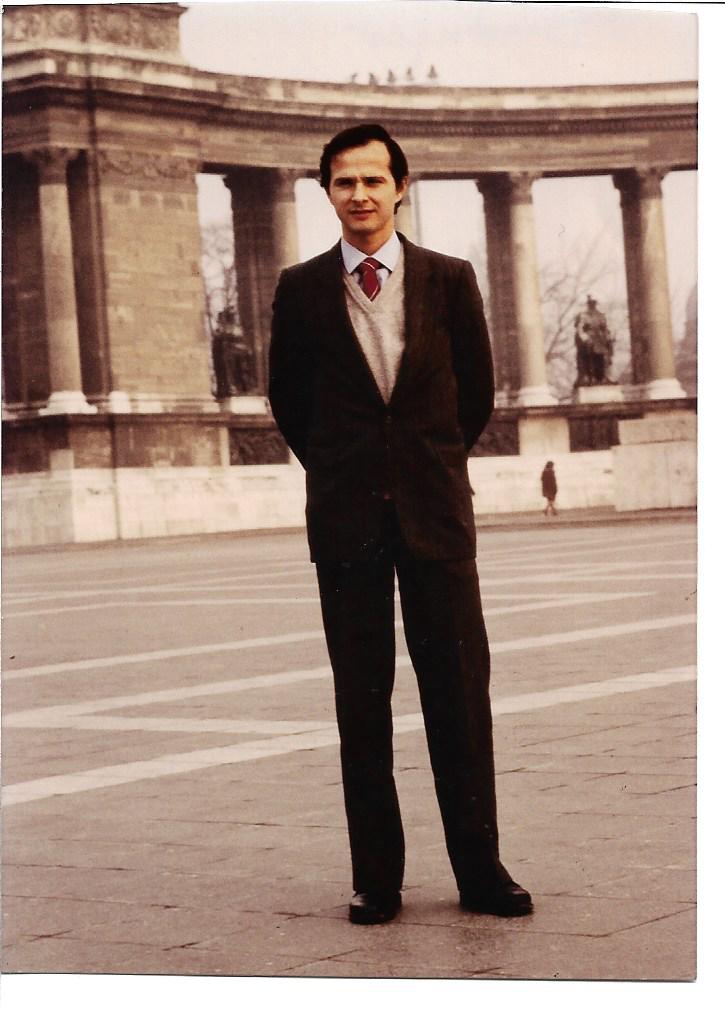
Bernard Martoïa is a retired French diplomat (1980-2017).
The photo to the left was taken in Budapest in January, 1983.
 The Tomahawk Creek Review