
The Oranges of Tobolsa
by Stuart Rose
I set off on the road for Tobolsa to feast on the oranges of my youth and then die. But Rodrigo, these oranges, you’ve no idea of their crispness and delight—I remember how as a boy they fell from the trees that dotted the hillsides of Tobolsa, the oranges rolling down the gentle green slopes when it was time, and I’d stand at the bottom of the hills and watch them come and if I was very lucky, then an orange would brush by my ankle and I’d feast. Mi abuela would say that the rolling of the oranges would make them sweeter, for the rolling released the nutrients within, and in those days I believed every word she said. It was a long time ago now, and I have since made my home very far away.
Now let me assure you Rodrigo, for you might have curiosity—my name isn’t worth the time it takes to write it down. You can see with your eyes that this parchment is small, and I don’t have much time, and anyway you will know who I am by the end of this tale. My trade is, or was, not worth mentioning either. Strange how twenty five years can pass without incident. And as to who you are, you’re going to have to figure that out on your own, Rodrigo. I cannot help you. Each man is his own island, and that island is a jungle, and I am too busy hacking through mine. I must get to the oranges, you see.
Let me start at the beginning, which is to say at the end of my former life. I was strolling to my place of work through the summer market one day, as I so often did at that time of year, swinging my brown leather briefcase so full of words without meaning, my eyes on the sunken bricks so as not to invite a conversation with my fellow townspeople. It was in that moment of inauspiciousness, so much like any other in my life back then, that I came to a sudden realization. The rising sun hit the back of my neck, and the first sweat of the day was just breaking under my white cotton suit, and perhaps I smelled the oranges even then—I don’t know. I tell you Rodrigo, it hit me like a gong, and I stood riveted in the center of the street as the reverberations shook me. Of course, the people bustled around me without care. Everyone was going somewhere or selling something. The stall closest to me was hawking small wood-carved statues, the same as the small wood-carved statues two and three stalls down. My realization was this, and it was really very simple. I did not want to go to my place of work. I wonder Rodrigo, if a man like you can understand that? I did not want to open my office door and say good morning to my secretary, did not want to open my briefcase and examine my meaningless papers, did not want to look over my investments and meet with clients and go over the cases of the day. The only activity that sounded beneficent, which is to say the sole activity that left a pleasant taste in my mouth, was to turn around and flee to my beautiful home and hole myself up in my library with my trashy and wonderful books.
My housekeeper was surprised to see me, as was my cook. But I did not feel the modest pang of guilt I was supposed to feel. I walked right past them, down the white-tiled, plant-filled hall, to the shining cherry-wood door of my library. As I was bathed in the light from the arched stained-glass window, I knew I was in the right place. From deep within me, I let loose a sigh of contentment, one I had perhaps been holding within me for years.
My library was the most beautiful room in my most beautiful home. It was shameful that I had hardly entered since it was constructed. Ovular in shape and spanning two stories, with a small wood ladder that could reach the topmost shelves, the cornices and casements and their contents burnished in the late morning light. If the library was an eye, then its pupil would be my reading chair, a chaise lounge of brown leather, placed in the center of the room. I brushed my hand against the nearest shelf of books. Some were of timeless leather, others were cheap paperbacks, but the colors of the spines melded together to form a wonderful mosaic. Each was an undiscovered country or perhaps a friend to be met. When it had come time to fill it, I insisted that all of the library’s books be what mi abuelo called trash—leather-bound copies of the adventures of Don Quixote and the Three Musketeers, the tales of Odysseus and Alice and Miss Elizabeth Bennett. It’s extraordinary how many trashy and wonderful books there are, Rodrigo. I gazed up and around at them, the books swirling in my delight. It was a tragedy of Elizabethan proportions that the vast majority of these books were left uncracked. I had been too occupied with what was in my briefcase, Rodrigo. But now …
I unloosened my collar and got to work. Alice was just going through the looking glass when my thoughts turned to the oranges of my youth for the first time in many years. Now, I must warn you Rodrigo, what follows is as trite a description as the worst poets could muster, but it was as though a flame was sparked in my head. I remembered how the oranges would roll down the green hillsides, how I’d set about licking my lips afterwards to get a last taste of that tangy sweetness, how mi abuela would scold me with utmost affection when I returned to her with a bellyful right before dinner. I smelled the oranges then, in my little library. It was faint, but I was not mistaken—the crisp clean scent of the oranges of my youth had arrived through the open window. I was drawn. I rose from my brown leather chaise lounge, planted my elbows on the window-sill and inhaled.
Now describing to you the oranges of Tobolsa would be a waste of words, for you cannot possibly imagine their sweetness, Rodrigo. No other orange on earth can compare, in smell or taste or even in pleasing design. But perhaps you are of a curious nature, and you begin to speculate. I must warn you, it would be like comparing a butter knife to a bayonet, for each slice of the orange cuts so deeply that it would penetrate even your god-forsaken soul. Tell me Rodrigo, do you recall that boy who begged for change outside your office door with his broken guitar? Now compare that ill-playing boy to sitting front row at the capital teatro for a concerto conducted by Vivaldi himself. It is no exaggeration, for the aftertaste of the oranges just start to crescendo when all other oranges fall quiet. And Rodrigo, before you chide me, I must remind you that I am no poet—I am just a man who wants something, and we are still at the beginning of this desire, so let us move on.
I spent much of the coming days in similar fashion. Instead of going to the office, I would shut myself up in the library with my glorious books, reading until my eyes filled with tears. I still walked the streets of my humble town and visited the market, but mostly I stayed at home, taking afternoon siestas on the back patio, the sun shining on my open shirt and nodding head as the palm fronds stirred in the breeze. My housekeeper and my cook were disturbed at first, but not overly so, as I continued to pay them on time.
At times, my thoughts couldn’t help but turn to my old life of work and how I became ensnared in it. Most get ensnared somehow, but for others, I imagine it was a passionate love affair they sought to nurture and grow, a surprise child or a noble profession or a lust for wealth and power. But me, I was simply following what I assumed everyone else to be doing. Perhaps that’s why, when I thought of my old life, it felt so without life. And at some certain indistinguishable point I started not to care. I simply went about performing my rote tasks—filling my briefcase, going to the office, making sound investments, playing bridge at the social club on the weekends, and all the while the not-caring was growing inside me. It was extraordinary how many things I did not care for. I would walk the streets and think, “I do not care for this little red sign,” and “I do not care for this bouquet of green flowers, or for this or that person who is passing me by.” My do-not-cares filled me up until they overcame me. It is unfortunate that I did not recognize this until it was too late.
As I spent more days reading and lounging in the library, I began to feel a sharp pain in my abdomen. I went to my doctor. He said it had been growing in me for years and was just now presenting itself. Me, I think the not-caring filled my life until it outweighed everything else and that was when the cancer crept in. My doctor said there was no hope. I did not care. I just wanted to get back to my books and my meals and my siestas. He said my senses would blossom and grow strange and then die. He said it would be very painful. I nodded my head as I sat on his cold examination table, the crisp white paper crinkling underneath me.
The doctor was prattling on about timelines and treatment options when the scent of the oranges filled the room. This was the second time I smelled the oranges of my youth, the oranges of Tobolsa, and the scent had grown from faint to full-blooded and crisp. I swooned as I sat on the cold examination table. Don’t ask me where the scent came from Rodrigo, for the room was windowless and cruel.
“Is something the matter?” asked the doctor, seeing how joyous I was.
“Do you smell that wonderful smell?” I responded in a rapture.
Over his glasses, the doctor looked at me with some concern. Slowly, he shook his head.
“Well that is unfortunate, for it is a most wondrous smell,” I said, and I took another mighty breath.
“Can you describe it for me?” asked the doctor. His clip-board was out, and his pen was poised.
“Oh no. I don’t think so, Doctor. Some things are beyond words,” I replied, leaning back my head and allowing the crisp clean scent to fill me.
My new and wonderful life blossomed thereafter, for a while at least. The oranges reigned over me. I requested them at every meal—pasta with orange sauce, orange ice cream, soufflés and truffles and duck confit, all with oranges. The more I ate, the more I craved the oranges of my youth, the oranges of Tobolsa, for really there was no comparison. My cook was a good one, but no cook can overcome mediocre ingredients, and my village was known not for its oranges but as a place to make sound financial investments with wise men who wore neckties. Tobolsa was far away.
And before you ask Rodrigo, no, I was not curious enough to follow the scent, or to even have that cross my mind beyond an idle thought or two. Can’t you understand that I was in my very necessary and delightful chrysalis, you fool? I was an old man then, in many ways much older than I am now, and braving the road to Tobolsa was a task for the young and foolhardy, not for rich and idle old men who just received bad medical news. Ah but Rodrigo, I can see you still have questions. Can’t you just sit still and listen to my stirring tale? To guess your thoughts is to journey inside the mind of a fiend. Hereafter I must be cautious, for you would pluck the fruits of my tale just as they are blossoming. And so, to your unholy questions. No Rodrigo, I never dared to question the source of the orange’s power. To do so would be to question the virginity of the mother Mary herself. And no, it was not possible that the oranges of Tobolsa could be captured by just the right breeze and carried across hillsides and rivers until the scent arrived beneath my nostrils. By God, do you cross every “t” and dot every “i” in your dreams as well? When the scent of the oranges came, I thoroughly enjoyed it and did not overly question it, for to question a thing such as this is to pick it apart until it is no longer living. Where the scent came from, the how and the why and the which, did not interest me so much as leaning my head back and inhaling.
I apologize for the above, Rodrigo. It’s just that you remind me of my old life. And I suppose you are performing a valuable function for me, so herewith I shall attempt to treat you with a modicum of respect, my friend. If I could go back and erase the words, I would. But I don’t have much time, and honestly, I think the words are sort of funny, so let us move on.
It was around this time that I started wrapping myself in an orange bed sheet like an ancient Roman. I found it to be very comfortable, and anyway belts and pants only led to pain in my belly. I started searching out stories with fruit in them, though most proved misleading. “The House of the Pomegranates” by Oscar Wilde, the stories of Johnny Appleseed, “Huckleberry Finn” by the American Mark Twain. I began writing very bad poetry, a few political diatribes against the working life that was spreading like a plague across my country, but mostly my poems were about oranges. Don’t worry Rodrigo, I will not share this poetry with you. I also began to spy quizzical looks on the faces of my cook and my housekeeper, and on the people in the street as I walked by them in my crisp orange bed sheet. I did not care. I was happy, though sometimes the pain in my abdomen overcame me.
The power of the oranges grew greater. To come upon the scent as I opened a fresh book or strolled through a forgotten room was so indescribably wonderful that I dare not describe it. Can you understand that, Rodrigo? That there are things, such as the crisp clean scent of the oranges, that burst forth from the spreadsheets and dictionaries of this world because they cannot be defined and deadened? At night, I dreamed of them, of the oranges rolling down the hills to me, and my grandmother beside me whispering their secrets as they came. I’d awaken alone in my old frail body filled with the orange’s scent, and I’d walk to the window and gaze at the round dimpled moon. I’d think of mi abuela then. I’d think of her end, her pain, how tightly she held my hand as she passed, and how I was never the same after.
When it was time, my new and wonderful life withered on the vine. I ran out of cash, you see. Now, don’t get me wrong Rodrigo, I still had plenty of wealth, I just ran out of the fluid part of it. And I dared not open my briefcase and go over my investments. That old and cursed life was finished forever. One day, my secretary came to the door and had me sign a series of documents. What they were, I do not know. She begged me to do more, for she has always been loyal to me, and I believe she had my best interests at heart, but if I thought for longer about it, about liquidating this or that and transferring it here or there, then my old life would come roaring back and try to devour me, and anyways, I was too busy reading my books and taking my siestas and feasting on false oranges, and dreaming of the real ones at night. Still, I was happy.
I missed a payment to my cook and my housekeeper. I missed another, and both confronted me as I sat reading “The Bow of Orange Ribbon,” which was a fairly good tale, its one flaw being that it did not have enough oranges. There was nothing I could say to them, to my cook and housekeeper, I simply smiled and watched them from my chaise lounge as they became angry, then resigned, then very sad. Eventually, they left, and I was alone in the house. It was wonderful, at least for a while, for I was not bothered. I could really dive in to the books now, and the scent of the oranges still lingered. Instead of people, I had books, neat friends I could pick up and put down and share a not-so-painful ending with, and when it was over all I had to do was walk to the shelves or hop on the ladder and pick out another. My meals, however, suffered greatly as did the overall cleanliness of the house.
Some business associates came to see me, but I never let them in. Perhaps you were among them, Rodrigo? I do not recall, for my mind grows smooth and round and dimpled as my insides wither. These associates took in my wild hair and stained orange bed sheet, and I took in their light cotton suits and constricted neckties, and whatever they wanted to say died on their tongues. They left without a fuss, and I was contented once again.
But life is a tricky meal to get right. One needs so many ingredients, you see. There I was, so pleased to have fled from my former life, safe at home and surrounded by books, and what was missing? People. I did not care much for people, but somehow I still missed them. I believe I missed more the idea of them, of having friendships and sharing in love and perhaps taking turns bending a sympathetic ear. I had never really had it, you see. And in fact, I fled from it after mi abuela passed. But do not pity me, Rodrigo. If you do so, then I shall take that as license to scorn you until the end of my days, which admittedly will come very soon.
Though I was suffering, I did not want to go out and share in the false friendships of the social club, wander into a shop and be accosted by a hawker of wares, or even bend the ear of a grocery clerk as he bagged my items. In short, I had no true friendships I could rely on. The pain in my abdomen grew worse. Sometimes, I would awaken in the middle of the day convulsing, the book I was reading falling to the floor. But not all was despair—I still smelled the oranges. When I turned the page of a new book or wandered through an old room, I’d be surprised with the crisp clean scent, and I’d imagine the bright round oranges rolling down the hillside to me, and perhaps brushing my ankle. It filled me with a wonderful, invigorating hunger. The scent, however, was growing fainter. Perhaps it was competing with the rising rotten smell of the trash scattered about my home. The thought was drifting more and more across my smooth and dimpled mind to follow the scent, but the road to Tobolsa was filled with bandits, and anyway, I was still contented in my home.
I suppose in retrospect that I thought I could cure myself in books. By the end, I was spending nearly every hour in the library. I spoke to no one. I never left my home. I was devouring the books, but the words turned on me, Rodrigo. In the end stories are not people, no matter how much I wanted them to be. More and more, I began to think in words. Oh, how I expostulated in them! I proclaimed and pronounced and appealed, all to empty rooms. I do not know if you have ever suffered from this affliction, Rodrigo, but it is horrible. To picture the word orange in black-and-white instead of that wonderful color is a most heinous disease. Still, day after day, I tried to drown myself in the books, the words crawling over my body like a living tattoo. The pain in my abdomen grew worse, sneaking up on me and knocking me down in the kitchen, in the garden, and as I made my toilette. The worst part? The scent of the oranges had all but left me. I began to imagine that I imagined it, the wondrous crisp and clean scent broken down by half-rational reasonings. My poetry, already quite horrible, suffered still more, for the words I wrote conjured nothing but more words. I was left to wander alone in my beautiful and empty home, wrapped in a bed sheet, having a detailed back-and-forth conversation with no one.
One day as I finished the rousing adventure of “Sherlock Holmes and the Five Orange Pips,” which was really quite good beyond my usual complaints, I caught a faint scent coming from my window. I rose, the cancer stabbing me in the belly and went to the window.
It was the oranges, of course. There was something overripe about their smell now. This was more distressing to me than the cancer inside me, or the fact that I was down to eating black bananas and rotten mango-skin. My thoughts turned to the village of my youth.
Rodrigo, I know how much you like your mystery novels, especially when they come to a neat and satisfying conclusion, but surely even you must know that is not how life really works. Therefore, you’ll be disappointed to note that there was much mystery about what happened to the oranges of my youth, the oranges of Tobolsa, and nearly all of it remains unsolved. Some say the whole of the village and its surrounding hillsides were flattened to make room for a highway that was re-routed at the last moment. Some say the village is still there, proudly living the old ways and disregarding the new. I lost all contact with any family there long ago, and I never had much to begin with, just my grandmother and me and for a short and terrible while, my grandfather was there also. I know that the oranges were never shipped out and industrialized, for I had my cook try to track them down, and he was really quite good at such things.
I leaned out as far as I could from my library window and smelled the still-wonderful smell. It was dusk in my village, the sweltering summer heat had cooled and everything was hued in blue. A waxing moon was on the rise, draped lovingly in gray cloud. I looked down at my soiled and stained orange bed sheet. I looked back at the pile of books gathered around my chaise. I thought of how disordered my home had become. My abdomen pained me then, almost enough to knock me down, the sharp stabbing that was the cancer growing. What kept me from falling was the scent of the oranges. I could just see the road out of my village, distant switchbacks that cut up the dark green hillside, a grove of palm fronds before it. Now Rodrigo, will you allow just one adverb to a poor destitute poet such as I? Then it will be—the palm fronds before me swayed invitingly in the gentle evening breeze.
Yes, the oranges were beckoning. And so quite simply and without a fuss, I put on the closest pair of sandals I could find and opened the door to follow the scent, and that was how I came to be on the road to Tobolsa.
ψ
Author’s Note—This is the first part of a novella.
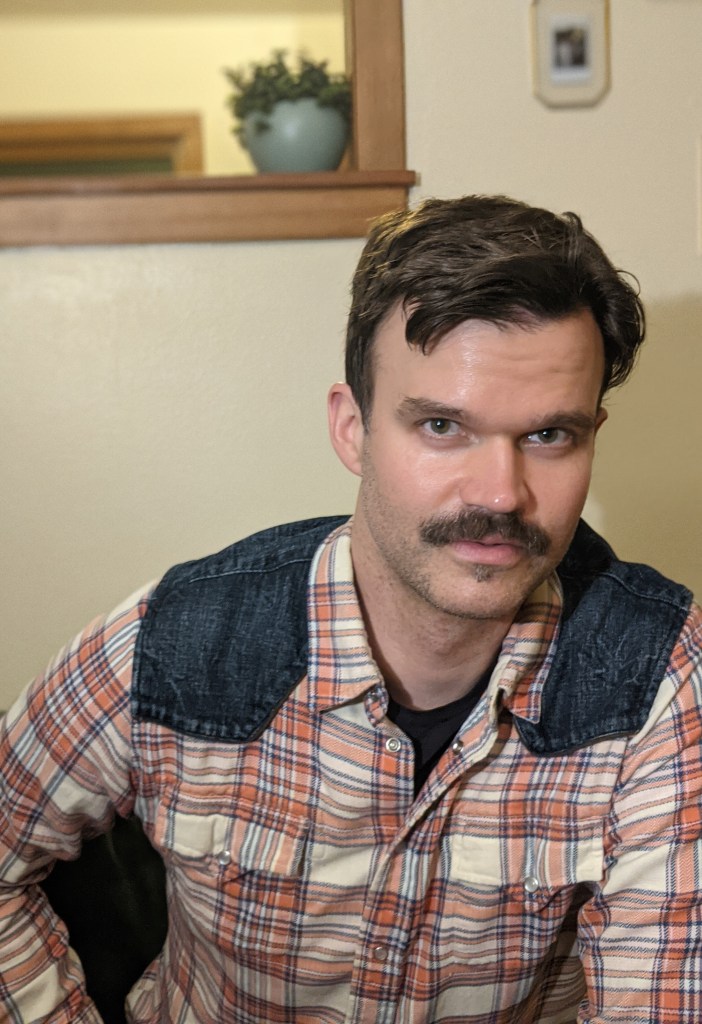
Stuart Rose works trails for the US Forest Service near his home in Missoula, Montana. He recently graduated with an MFA in creative writing from the Rainier Writing Workshop. He likes rubber duckies, but not in a weird way.
 The Tomahawk Creek Review